Against unlawful checks at Germany’s EU borders
Checks at German borders are unlawful, but have become common practice again. The GFF is taking action in several court cases.

Each time you cross the border, you have to expect a police check. Before or after a vacation, this may just be annoying. But what if you have to cross the German-Austrian border several times a week for work, for example? What if you are the only one checked on the train because of your skin color? What if you have had such bad experiences with police officers during checks that you are afraid of crossing the border again?
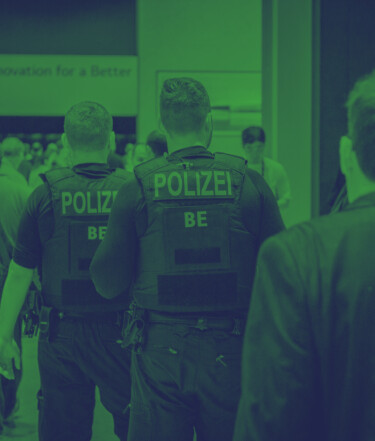
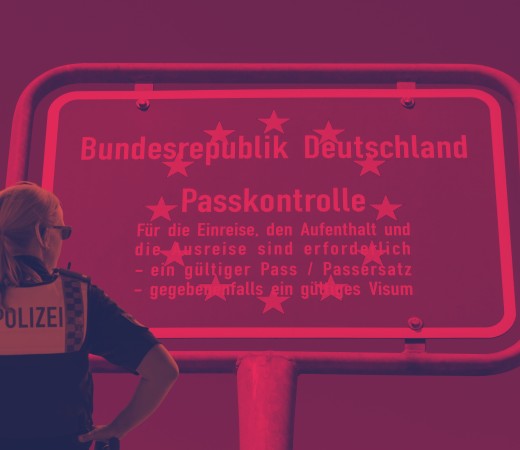
The internal border checks that have been in place at all German borders since September 2024 affect many people. What's more, they are unlawful, as the European Court of Justice and the Bavarian Administrative Court have already ruled. Nevertheless, it is common practice for cars to queue up at borders because of the checks and for officials to ask commuters on trains for their ID, at times rather forcefully. The GFF is taking legal action in several cases against this disregard for the rule of law. The aim is to end the unlawful checks at all German borders. As part of a strong alliance, the GFF wants to join forces to take legal action and increase pressure on the Federal Ministry of the Interior to end these violations of European law.
The individual cases clearly show how differently internal border controls affect people's lives.
Time delay
The GFF supports people such as Innsbruck law professor Werner Schroeder, who lives in Munich. On one of his train journeys across the border, he pointed out to federal police officers that internal border controls were unlawful. The officers nevertheless forced him to show his ID. We are taking legal action before the Munich Administrative Court.
Transgressions
The GFF supports travelers such as Sandra Alloush, a Syrian woman living in France. On her way to a professional appointment in Berlin, police officers accused the journalist and documentary filmmaker of lacking sufficient papers. She was taken to the police station against her will, searched, and fingerprinted. She was then sent back across the French border on foot. Her experiences left her feeling afraid, which is why she is now avoiding crossing borders.
Together with the human rights organizations European Center for Constitutional and Human Rights (ECCHR) and European Network against Racism (ENAR), we are taking legal action before the Administrative Court in Freiburg/Breisgau.
Institutional racism
The GFF advocates for train passengers on a cross border journey who are the only travelers to be subjected to border checks, which may be racially motivated. “Racial profiling” means that officials check people based on their appearance or the language they speak, regardless of suspicion. We are taking legal action before the Munich Administrative Court together with the association “Equal Rights Beyond Borders.”
Germany's reintroduction of internal border checks threatens one of Europe's most important achievements: citizens are free to move within the Schengen area (Europe excluding Ireland, Cyprus, plus Norway, Iceland, Switzerland, and Liechtenstein). This simplifies economic transactions and private travel and helps to facilitate personal contact between people across borders. People depend on this freedom for various family or professional reasons.
The German federal government justifies the controls with a blanket statement about a threat situation. It does not cite any actual evidence that the controls make Germany safer. Instead, the random checks carry the risk of discriminating against people and making them unnecessarily afraid of traveling freely. The border checks also undermine confidence in the rule of law when the Federal Ministry of the Interior ignores court rulings.