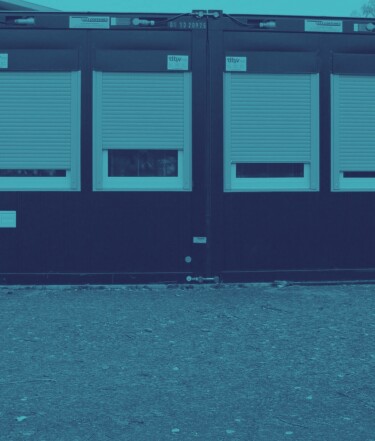

Exclusion from benefits pushes refugees into existential hardship
Refugees whose asylum proceedings are supposed to take place in another EU country do not receive social benefits in Germany. This is a triple violation of the law: EU law, fundamental rights, and international law are all affected! We are fighting back: in court and before the United Nations Social Committee—against an exclusion that forces people into homelessness and hardship.

WHAT THE EXCLUSION FROM BENEFITS IS ABOUT
Since the end of October 2024, a new provision in the Asylum Seekers Benefits Act excludes so-called Dublin refugees from receiving benefits. This affects people who first entered another EU member state and then traveled on to Germany. In such cases, the country of entry is responsible for the asylum procedure. Germany could transfer these persons to the country of entry if their fundamental rights are guaranteed there, but it does so only very rarely (Dublin transfers 2024, Refugee Council of Lower Saxony). Instead, since the new regulation came into force, those affected have had their social benefits withdrawn in Germany so that they return of their own accord rather than living in poverty. As a rule, such departure is not possible for those affected who are not EU citizens. The entire organization of this departure is in the hands of the authorities in Germany and in the country of entry. Above all, however, it takes time. Nevertheless, the new regulations deny people their right to a minimum level of social security after a two-week transition period, during which they already receive significantly reduced benefits. They will only receive benefits in cases of extreme hardship, whereby homelessness, for example, is not recognized as such a case of hardship. Those affected become homeless and destitute – and this is solely due to their residence status, because no one is looking closely at whether it is actually possible for them to leave the country.
Eyes wide open to the violation of fundamental rights
GFF experts already pointed out the impending legal violations during the legislative process and made it clear that those affected are threatened with homelessness and destitution in practice. The exclusion of benefits in the Asylum Seekers' Benefits Act, which has been in force since the end of October 2024, violates the guarantee of a humane minimum subsistence level. The minimum subsistence level guarantees the absolutely necessary means for a dignified life. This human right applies to all people who cannot provide for themselves adequately. It applies equally to German and foreign nationals - this was emphasized by the Federal Constitutional Court in 2012.
Incompatible with European law
The exclusion from benefits also violates the applicable European Reception Directive (Directive 2013/33/EU). The directive stipulates that the EU country in which the person seeking protection is located must always ensure an adequate standard of living. As long as refugees are in Germany, Germany must therefore also ensure their livelihood. The Federal Social Court already considers a reduction in benefits for those affected to be likely incompatible with the directive (ECJ, C-621/24) – but if a reduction in benefits already violates the directive, then the complete cancellation of benefits certainly does.
VIOLATION OF THE UNITED NATIONS' BINDING MINIMUM SOCIAL STANDARDS
The new regulation disregards the International Covenant on Economic, Social and Cultural Rights (ICESCR, German Institute for Human Rights). The so-called Social Covenant obliges states to guarantee non-discriminatory access to economic, social and cultural rights. This includes access to a social system that provides all individuals and families in economic need with a minimum level of essential services. They must receive at least basic health care, housing, water, sanitation, food, and education. The rights under the Covenant apply to all people, regardless of their residence status and papers. The rights under the Social Covenant have the same status as any German federal law and must always be taken into account when interpreting German laws.
Success in two summary proceedings
In April 2025, the Hamburg Social Court clarified in two summary proceedings, which we conducted together with attorney Malena Bayer, that as long as voluntary departure is not actually possible in the near future, the exclusion of benefits is unlawful (S 7 AY 196/25 ER and S 5 AY 195/ER). In Hamburg, those affected receive significantly reduced voluntary benefits from the authorities. Here, too, the authorities do not check in advance whether prompt departure is actually possible. This administrative practice is a clear violation of the right to a decent minimum standard of living.
Since then, numerous court decisions have been handed down on the basis of the Hamburg ruling, which uphold the applicants' claims and award them full benefits (here is an overview from GGUA Refugee Aid). In particular, the Lower Saxony-Bremen Regional Social Court, in its decision of June 13, 2025 (L 8 AY 12/25 B ER), strengthened the protection of fundamental rights with reference to the Hamburg case law!
The Free and Hanseatic City of Hamburg has not yet adapted its administrative practice. This is a clear violation of its obligation to uphold the law.
INDIVIDUAL COMPLAINT TO THE UNITED NATIONS WITH A MILESTONE VICTORY
On September 29, 2025, we filed the first individual complaint from Germany with the United Nations. Since July 2023, if German courts fail to provide timely assistance, people in Germany can appeal to the United Nations Social Committee to assert their rights under the Social Covenant. So far, no one has made use of this option—we are doing so now, sending a signal for social human rights and showing that it is feasible!
Background information on the UN Social Covenant
The International Covenant on Economic, Social and Cultural Rights (abbreviated as the “UN Social Covenant” or “WSK Covenant”) is an important agreement on human rights (here is the text of the covenant in German and English). The agreement was adopted by the UN in 1966. Germany ratified the Social Covenant in 1973. Since then, it has been a binding part of the German legal system. Germany must observe and implement the rules of the Social Covenant. Since 2023, individuals have been able to submit individual complaints via an Optional Protocol if their rights under the Covenant have been violated. They can demand redress and compensation from Germany for human rights violations if no legal protection could be obtained in German courts within a reasonable period of time.
The Social Covenant obliges states to guarantee non-discriminatory access to economic, social, and cultural rights.
Important rights in the Social Covenant include, for example:
- Right to health
- Right to education
- Right to work
- Right to housing
- Right to water and toilets
- Right to participate in cultural life
Together with a 20-year-old affected person from Thuringia, we are conducting proceedings against the exclusion from benefits. He fled the war in Syria and entered the EU via Malta. He arrived in Germany last summer, where three of his aunts live. After his asylum application was rejected because, under EU law, only Malta can decide on it, his social benefits were completely cut off. The authorities did not check whether it was actually possible for him to leave the country.
In mid-February, he had to leave his accommodation and hand in his health insurance card. He has been homeless ever since. He lives on donations from friends and volunteers, but this does not prevent him from often having nowhere safe to stay at night. In a community where over 40% voted for the AfD in the last federal election, the situation is particularly stressful and frightening for a refugee. He often has nothing to eat for days, no sufficiently warm clothes for the increasingly cold nights, and no access to washing facilities – a situation that takes a heavy toll on him physically and mentally. It goes against his self-image to be dependent on donations, but he sees no way out.
Supported by attorney Dr. Christian Scheibenhof, he has already attempted to take urgent legal action against the exclusion from benefits before the Gotha Social Court and the Thuringian State Social Court. However, as far as is known, the Thuringian State Social Court is the only state social court that considers the exclusion from benefits to be lawful (Thuringian LSG, decision of May 16, 2025, L 8 AY 222/25 B ER).
Together with the GFF, he has appealed to the Federal Constitutional Court, which, however, referred us to the Meiningen Administrative Court in its decision of June 30, 2025, to bring proceedings before the Meiningen Administrative Court regarding the residence status of the person concerned ( 1 BvR 1200/25). We did so and lost the case there due to the clear legal situation in asylum law (VG Meiningen, decision of September 4, 2025, 9 K 1830/25 Me, unpublished).
Now the way is clear, and together with attorney Dr. Christian Scheibenhof, we have filed an individual complaint with the United Nations against the exclusion from benefits. In it, we request both rapid support for the person affected and the abolition of the exclusion from benefits. If our complaint is successful, the United Nations can call on Germany to do this. The exclusion from benefits violates the young man's right to social security (Art. 9 of the Social Covenant), to an adequate standard of living (Art. 11 of the Social Covenant), to health (Art. 12 of the Social Covenant), and to the exercise of these rights without discrimination on the basis of his residence status (Art. 2 (2) of the Social Covenant).
In October 2025, the UN Social Committee responds while proceedings are still ongoing: the complainant is to receive provisional subsistence benefits covering food and accommodation (see the UN Social Committee's order for provisional measures against Germany). In cooperation with lawyer Dr. Christian Scheibenhof and the Thuringia Refugee Council, we achieve this milestone victory with the new legal instrument of individual complaints. With its announcement to Germany, the United Nations signals that it sees a threat to social human rights. The Social Committee's order is binding. The Social Committee has already made this clear in several proceedings (see our letter from the ongoing court proceedings of November 14, 2025, with numerous references to the obligation).
We have repeatedly called on the authorities in the Ilm district to take action. On October 27, 2025, they refused to provide any assistance. The Federal Ministry of Labor and Social Affairs, which is responsible for the proceedings before the UN Committee, has not responded since then. According to media reports, they are reviewing the implementation (see Tagesschau report dated November 13, 2025).
Update: The social welfare authority in the Ilm district has now offered the complainant a bed in a shelter, but continues to refuse to provide food, clothing, soap, money, and urgently needed medical treatment (see letter from the authority dated November 11, 2025). This is a completely inadequate offer. The authority does not justify the accommodation offer on the basis of the obligation imposed by the Social Committee, but rather on the basis of an obligation under the Thuringian Refugee Reception Act (§ 1 ThürFlüAG): It has left open the question of whether the complainant should pay the usual fees for accommodation (§ 6 ThürFlüAG). The authority does not comment at all on the obligation imposed by the UN Social Committee. We are already conducting proceedings on this matter at the Gotha Social Court and are considering further legal steps.
STOP UNCONSTITUTIONAL MIGRATION POLICY
Legislators are currently planning further tightening of the law with the draft amendment to the GEAS Act (see draft law of September 3, 2025). The new law is intended to make it explicitly clear that authorities are no longer obliged to check whether departure is even possible in individual cases. But this is the wrong approach – fundamental and human rights cannot be undermined by tougher laws. Anyone who is here is entitled to a minimum level of social security! Exclusions from benefits that are far too sweeping are and remain unconstitutional. We will continue to fight for the protection of fundamental rights in court – and now also for social pact rights at the United Nations!

Freedom needs fighters
Gemeinsam für die Grundrechte vor Gericht