Large-scale AI-supported video surveillance in Frankfurt city center
The police in Frankfurt are using real-time biometric video surveillance in public spaces. Using artificial intelligence, they collect and analyze data on everyone within the cameras’ field of view. Such extensive surveillance constitutes an impermissible infringement of fundamental rights, such as the right to privacy. That is why we are filing a lawsuit with the Administrative Court of Frankfurt am Main.

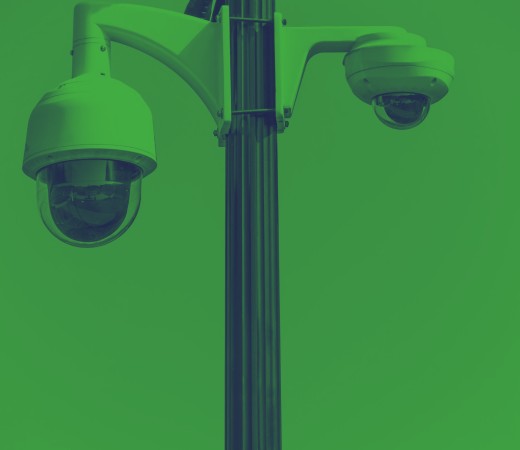
Biometric data allows a person to be uniquely identified based on physical characteristics or behavioral patterns. Since July 2025, the Hessian police have been testing real-time biometric facial recognition in Frankfurt’s Bahnhofsviertel district. Using six AI-supported cameras, they capture facial features and movements of people in public spaces and compare them in real time with police databases. The police want to use this technology to identify individuals who pose a terrorist threat. They also hope to use it to find missing persons and victims of kidnapping, human trafficking, or sexual exploitation. The police have now expanded the use of this AI system to two additional locations in the city center—and it is expected that more locations will follow.
The AI registers both wanted and unwanted individuals alike. In order to identify a specific person, the system must first compare all individuals captured on camera with reference data. As a result, everyone who enters the camera’s field of view is biometrically recorded—even before it is determined whether they are connected to an active search. In this way, the police process vast amounts of highly sensitive data on uninvolved individuals.
When Surveillance Gets in the Way of Help
One of the cameras is pointed directly at the entrance to the Doña Carmen e. V. support center. Sex workers go there to seek accessible assistance with social, legal, and health issues—often in urgent situations.
Even before they enter the building, a camera across the way captures their biometric data. For people in difficult life situations, this can mean that they may not dare to seek help in the first place out of fear or shame. For a support center that relies on trust and confidentiality, this is a major problem. People who have experienced sexual violence or exploitation are particularly affected—in other words, precisely those whom the surveillance is actually intended to protect.
For women who come to us for advice and support, anonymity is very important. They feel intimidated and unsettled by constant surveillance. This also applies to our staff and members. This technology is actually meant to protect against crime, not to discourage women from seeking advice.
Being observed changes the way people behave
Since the Bahnhofsviertel district is considered a “problem area,” it serves as a gateway for mass surveillance. However, biometric data collection affects not only wanted individuals, but especially those who pass through the area every day. Those affected have no way of knowing when the cameras’ AI function is active. As a result, it is impossible to predict or control when the police will capture an individual’s image.
In its rulings, the Federal Constitutional Court has repeatedly characterized the intimidating effects of similar surveillance measures as a threat to fundamental rights. When people do not know whether or when their biometric data will be collected, they change their behavior: for example, they may refrain from attending demonstrations and avoid certain places. Social participation then depends on whether a person is willing to be monitored. Added to this is the risk that the state will link the collected data with other information—this could allow authorities, for example, to create movement profiles that enable far-reaching conclusions about people’s lives.
Susceptibility to errors and risks of discrimination
The fact that the technology is prone to errors aggravates the problem: AI facial recognition systems carry over biases from their training data. Studies show that the technology often performs worse when recognizing women, children, and people of color. As a result, these groups are at greater risk of becoming the target of follow-up police actions. This creates a risk of arbitrary police actions—including unlawful arrests.
Researchers are also observing what is known as “decision fatigue” among police officers: even though officers must still decide how to proceed after each result returned by the AI, they are increasingly relying uncritically on the supposedly reliable and neutral technology. The lack of transparency in these systems exacerbates the problem. Those affected by a misidentification cannot understand the decision-making logic and can hardly defend themselves effectively against it.
Severe restrictions on fundamental rights require strict legal limits
Biometric data deserves special protection because it can uniquely and permanently identify an individual. Collecting such data without a legitimate reason therefore constitutes a particularly serious infringement of the right to control one’s own data.
Such interventions are not prohibited in principle, but they require a clear and proportionate legal basis that sets binding limits. The current legal basis in Hessian police law (Section 14 of the Hessian Security and Public Order Act) does not meet these requirements: It is worded too broadly and permits its use even for purposes that do not serve to avert particularly grave dangers. Additionally, real-time biometric surveillance must comply with the strict requirements of the European AI Regulation—which is also not the case in Hesse.
A landmark ruling before surveillance becomes the norm
With our lawsuit, our initial goal is to have the case referred to the Federal Constitutional Court. We want the Court to establish binding standards for the use of biometric video surveillance and to declare parts of the overly broad legal basis in Hesse unconstitutional. In addition, we aim to have the case reviewed by the European Court of Justice. We want the ECJ to clarify the relevant provisions of the European AI Regulation.
Hesse is the first federal state to have legally authorized and tested remote biometric identification in practice. However, it will not be the last: Lower Saxony, Saxony, and Schleswig-Holstein have already introduced corresponding bills. The question of what limits the state must observe when using biometric surveillance will become increasingly relevant.