

Afghanistan Admission Program: Germany must uphold its protection commitment
The Federal Government must keep its word and protect Afghans who have been promised admission to Germany from deportation into life-threatening danger. We are taking it to court!

The Federal Government promised admission to Afghans at risk and accommodated them in Pakistan for the purpose of carrying out the visa process. This gives rise to a constitutional obligation to protect these individuals. The Government cannot withdraw from this obligation without substantive justification after two and a half years and knowingly expose these people to the Taliban, where they face the risk of torture and death.
Protection Obligation Arising from Admission Declaration
The complainant in one constitutional complaint served as a high-ranking judge in Afghanistan until the Taliban seized power. In this capacity, he convicted numerous members of the Taliban, including individuals who now hold senior positions within the Taliban’s political and military structures. Following their takeover, he received death threats and was forced into hiding. One of the individuals he had previously convicted abducted and killed the complainant’s father. Since then, the family lived in constant fear and under threat. At the end of 2022, the German Agency for International Cooperation (GIZ) informed the complainant that the Federal Ministry of the Interior had issued an admission declaration for him and his family pursuant to section 22, sentence 2, of the Residence Act.
The family subsequently structured their entire lives — including the future prospects for their children — around the expectation of entry to Germany and the completion of the visa procedure. In accordance with the instructions contained in the admission declaration, they applied for Pakistani visas. In order to fund their departure to Pakistan, they sold their house and all remaining assets in Afghanistan.
In Islamabad, the family placed themselves under the care of the German Agency for International Cooperation (GIZ) in a guesthouse and have since been living there under adverse conditions. Since the expiry of their visas in April 2023 and the resulting risk of deportation — that is, for more than two and a half years — they did not leave the accommodation at all, out of fear of deportation and at the instruction of GIZ. Despite a positive security screening and the submission of all required documents, their visas were not issued. In May 2025, the Federal Government announced a halt to all admission programmes and suspended the admission declaration.
Application for Interim Relief and Constitutional Complaint: Karlsruhe Urges Federal Government to Decide
In June 2025, the family filed an action and an application for interim relief in Germany seeking the issuance of visas and prevailed before the Berlin Administrative Court. The court held that the admission declaration gave rise to an entitlement to the issuance of visas. In August, however, the Berlin-Brandenburg Higher Administrative Court set aside that decision, holding that the admission declaration constituted a non-binding political decision from which the Federal Government could withdraw at any time and without giving reasons.
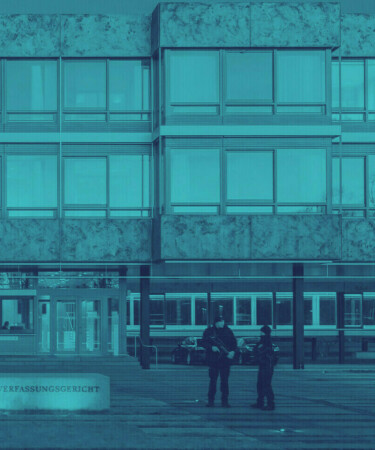
We subsequently filed an application for interim relief and a constitutional complaint with the Federal Constitutional Court against that decision. We argued that the admission declaration is binding on the Federal Government, relying on the constitutionally enshrined principles of the protection of legitimate expectations and the government's duty to protect life and physical integrity.
The Federal Republic of Germany formally declared the complainants’ admission in writing, instructed them to leave for Pakistan and to pursue the visa procedure there, and has accommodated them in a GIZ facility for almost three years. In reliance on this commitment, the family sold their house and all of their assets in order to fund their departure and the visa procedure and emerged from hiding in Afghanistan. There were no indications whatsoever for the family that entry to Germany would not be possible despite the admission commitment — subject to a successful security screening.
The Federal Constitutional Court partially upheld the constitutional complaint, finding that the lack of a decision on the visa applications violated the right to effective legal protection. The judges urged the Federal Government to decide on the visa applications without delay.
IMPORTANT SUCCESS: FAMILY CAN ENTER GERMANY
On 8 December, the Federal Government revoked all admission declarations issued pursuant to section 22, sentence 2, of the Residence Act. This affects approximately 640 Afghans accommodated in GIZ facilities in Pakistan, the majority of whom are women and children. On December 10, 2025, Human Rights Day, the family received their visa rejection notice.
The family and the other affected individuals now faced an imminent risk of deportation to Afghanistan and of falling into the hands of the Taliban. The Pakistani government had already announced that in early January, it would begin deporting all persons seeking protection under the German admission programmes. With the support of GFF, the family has once again filed a lawsuit and an application for interim relief with the Berlin Administrative Court.
Our efforts in court, the work of many other organizations, and media coverage had an impact: the Federal Minister of the Interior made a 180-degree turn and allowed the judge and his family to enter Germany after all. On December 22, 2025, the family landed—along with 135 other Afghans from other resettlement programs whose admission commitments the federal government considers legally binding.
STAGE VICTORY BEFORE UNITED NATIONS
On 16 December, the Federal Constitutional Court rejected the constitutional complaint of another former Afghan judge and his family. The Court noted that the family could seek legal protection before the administrative courts following the now-issued rejection of their visa applications. On the same day, we filed an application for interim relief with the Berlin Administrative Court.
At the same time, we consider recourse through the administrative courts to be futile and view the referral to this legal remedy as cynical: the clear case law of the Berlin Higher Administrative Court stands in the way of a successful interim application, and any legal protection would come too late given the imminent threat to life.
Together with the family, lawyer Farhad Bahlol, and Equal Rights Beyond Borders, we went to the European Court of Human Rights (ECHR) in December 2025 and asked for an interim order. Articles 2 and 3 of the European Convention on Human Rights (ECHR) protect people from being sent back to a country where they could be tortured or their lives could be in danger. Although the deportation itself is being carried out by Pakistan, Germany is knowingly initiating it by withdrawing its declaration of admission and revoking the protection it has granted the family for over three years. The ECtHR rejected the application for interim relief without giving reasons.
In January 2026, we filed a complaint with the United Nations Human Rights Committee together with Kabul Luftbrücke and the family, alleging a violation of the prohibition of torture (Art. 7 UN Civil Covenant) and the right to life (Art. 6 UN Civil Covenant). The Committee, which monitors compliance with the UN Civil Covenant, issued an interim protection order in the same month. In the interim protection order, the Human Rights Committee calls on the German government to use all diplomatic and legal means to prevent the family's deportation from Pakistan back to Afghanistan. While the individual complaint is being examined, Germany must ensure their safe accommodation in Pakistan. Interim orders issued by the Human Rights Committee are binding because they ensure that no irreversible damage is done until a decision is made on the main issue. European governments generally implement these orders. The order applies directly only to this family. In February 2026, the German government declared that it would guarantee the family's accommodation until the conclusion of the complaint proceedings before the United Nations and called on the Pakistani government not to deport the family.
However, the interim protection order sends a signal to all other similar cases: the committee makes it clear that Afghans who have been granted asylum in Germany can invoke human rights vis-à-vis the federal government, which must protect them from torture and death in Afghanistan until a final decision is made.
The complainants are also a former Afghan judge, his wife, and children. The judge was responsible for combating terrorism and corruption as a presiding criminal judge and, in this capacity, convicted a large number of Taliban members who, after the fall of the Islamic Republic in Afghanistan, now hold high-ranking and important positions within the political and military structures of the Taliban. At the time of their convictions, many of these individuals had already threatened the judge and his family with violence in the event of their release. After the seizure of power, he went into hiding when his house was searched, and he and his family initially fled to Iran and then, after receiving a declaration of acceptance from the German government, to Pakistan.
MODEL CONSTITUTIONAL COMPLAINT FOR INDIVIDUALS SEEKING PROTECTION WHO ARE PART OF GERMAN ADMISSION PROGRAMS
Together with Kabul Luftbrücke, we support Afghans whose German admission approval has been revoked in accordance with Section 22, Sentence 2 of the Residence Act.
While the federal government withdrew the admission approvals in December 2025 and the visa applications were subsequently rejected by the embassy in Islamabad, lawsuits against the rejected visa applications are pending before the Berlin Administrative Court. However, the case law of the Higher Administrative Court of Berlin-Brandenburg is clear. On several occasions, most recently in January 2026, the court has declared the admission approvals to be a non-binding political decision that can be revoked at any time (see, among others, OVG Berlin-Brandenburg, judgment of June 4, 2025 – OVG 6 B 4/24; OVG Berlin-Brandenburg, decision of August 28, 2025 – OVG 6 S 47/25 –, para. 3, juris).
Against this backdrop, it is inevitable that the case will be brought before the Federal Constitutional Court after the appeals have been heard by the lower courts. In preparation for this, we are providing those affected with a template to assist them in filing a constitutional complaint.
The model constitutional complaint and further explanations are available here.
An Afghan women's rights activist took our model constitutional complaint to the Federal Constitutional Court in February 2026. The court now has the opportunity to stop the German government's violation of its duty to protect.
FEDERAL GOVERNMENT'S FUNDAMENTAL DUTY TO PROTECT
The families concerned have relied on the Federal Republic of Germany's declaration of admission for years. The revocation of the declaration of admission is unlawful on the basis of the constitutionally enshrined principle of protection of legitimate expectations alone. Furthermore, by issuing the declaration of admission and taking the families into its care in Pakistan, the federal government assumed responsibility for the protection and well-being of both families to such an extent that, in this specific case, a constitutional duty to protect arises from Article 2(2) sentence 1 of the Basic Law. This is all the more true because the families now face an even more serious threat than before their departure due to their extradition from Pakistan to the Taliban.
The suspension of the admission programs does not only affect these families: around 1,300 Afghans with admission commitments are currently waiting in Pakistan under precarious conditions.
Attorneys Julius Becker and Farhad Bahlol are representing the families in court.
Work on this project is funded by the Mercator Foundation.

Freedom needs fighters
Defending fundamental rights in court