
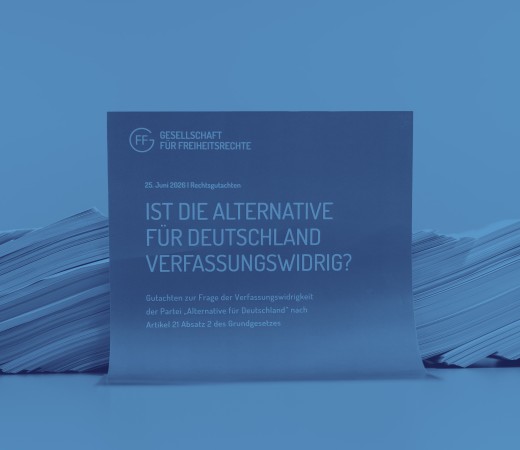
Everyone talks about it - we want to know! Expert opinion on the potential unconstitutionality of the AfD
There is still uncertainty in the political process as to whether the AfD can be prohibited. We now want to clarify it with a comprehensive expert opinion.
UPDATE: The expert opinion is moving into the next phase
Over the past few months, we have collected data and refined the constitutional standards for a potential party ban. Now it's time to select and evaluate the huge amount of evidence — including, for example, one million social media posts. To accomplish this task, we are also using AI models (LLMs) for pre-selection. We expect to be able to publish the report in early summer 2026.
The fact that there is a wide range of political parties with very different ideas and proposals in Germany is a valuable asset under constitutional law and an expression of democracy in action. However, the desired competition of political ideas also has limits laid down in the Basic Law: parties that aim to impair or eliminate our free democratic basic order are unconstitutional and can be prohibited.
LACK OF LEGAL CLARITY UP TO NOW
There has long been a growing number of voices that see the rhetoric, program and policies of the AfD and its members as a threat to the fundamental rights of all people and an open democratic society. For some time now, there has been much discussion about whether the AfD could be banned under Article 21 (2) of the German Basic Law. Efforts in the Bundestag to propose a ban have failed. One reason for this is that many MPs were unsure whether such a motion would be successful.
In recent months, there have already been numerous expert reports on this issue: expert opinions, statements, journalistic texts and specialist articles - and most recently, the Federal Office for the Protection of the Constitution (“Bundesamt für Verfassungsschutz”, BfV) categorized the AfD as “confirmed right-wing extremist”. However, no single institution has yet compiled all the information and examined in the necessary depth whether the complex legal requirements for unconstitutionality and therefore for a ban are met. The leaked BfV expert opinion does not answer this question either, as the categories “confirmed right-wing extremist” and “unconstitutional” are not identical – the BfV expert opinion does not address some aspects that are relevant for being unconstitutional. Moreover, it is unclear whether the BfV's conclusions will really stand up in court. The great uncertainty about a question that is central to our democracy therefore continues to this day.
A RESEARCH-BASED FOUNDATION FOR THE DEBATE ON PROHIBITING THE AFD
We want to put this discussion on a new, scientifically sound footing: Because the threshold for a party ban under Article 21(2) of the Basic Law is very high, it is all the more important to carry out this examination conscientiously, at the highest scientific level and with the best constitutional expertise. On the one hand, it is important to fully understand the AfD as an object of investigation and, on the other hand, to draw factually and legally viable conclusions based on the standards of the Federal Constitutional Court. Independent experts will review the findings.
Our report will be an important guidepost for the public debate. However, it could also shape other debates, such as those on the permissible AfD-critical activities of non-profit or publicly funded organizations.
The GFF has extensive experience with complex constitutional issues of significance to judicial policy. We are not alone in our project: the organizations
Campact,
Volksverpetzer,
innn.it,
Republikanischer Anwältinnen- und Anwälteverein (RAV),
Postmigrantischer Jurist*innenbund,
Frag den Staat and
Bleibt stabil support our efforts.
Do you have important information that is relevant to our AfD expert opinion? Here you can find out how to share it with us confidentially and securely.
FREQUENTLY ASKED QUESTIONS ABOUT OUR EXPERT OPINION
Why is the GFF preparing an expert opinion on whether or not the AfD is unconstitutional?
Parties that seek to undermine or abolish the free democratic basic order in Germany can be banned under Article 21, Paragraph 2 of the Basic Law. Whether it is possible to ban the AfD has been the subject of intense debate for some time, as many people see its program, rhetoric, policies, and the behavior of its supporters as a threat to democracy and human dignity. However, it remains completely unclear whether a motion to ban the party could be successful, despite numerous expert opinions on the matter. Even the leaked report by the Federal Office for the Protection of the Constitution does not answer this question.
With our report, we want to put the debate about a potential ban on the AfD on a new footing. That is why we are working with an open mind, at the highest scientific level, and with great constitutional expertise. We will have our findings reviewed by renowned experts and then publish them—including all supporting documentation.
When will the expert opinion be finalized?
The political and public debate can only be aided by an expert opinion that meets the highest legal and scientific standards. That is a lot of work. We aim to have it completed by early summer 2026.
How does the GFF fund the expert opinion?
We fund the expert opinion exclusively through donations. Through a campaign, we have raised over €900,000 from more than 18,000 supporters.
Who is working on the expert opinion and how is the team proceeding?
We have assembled a team of lawyers, experts on right-wing extremism, and researchers. Over the coming months, they will collect material on the AfD and evaluate it based on the standards developed by the Federal Constitutional Court for determining the unconstitutionality of political parties and further refined by our team where necessary. Our findings will then be reviewed by renowned experts.
Does the GFF receive information from the Office for the Protection of the Constitution or other government sources?
No. We only examine publicly available sources, such as statements made in parliaments, at events, or on social media. However, we have, of course, fully evaluated the report by the Office for the Protection of the Constitution, which was made public in May. This also applies to other reports by the Office for the Protection of the Constitution and the numerous court decisions on the classification of the AfD and its regional associations.
Which group of individuals does the GFF examine? Are statements made by ordinary AfD members also examined?
We primarily examine statements made by AfD officials and associations. These can be federal chairpersons, parliamentarians, but also posts from district associations. We only take statements made by individual members into account in exceptional cases, for example if they are particularly problematic and have been made without contradiction on a prominent stage.
Who does the GFF collaborate with to produce the expert opinion?
We are collaborating with several civil society organizations on the report: FragDenStaat is currently building a database where we can collect evidence. The Republican Lawyers' Association, the Postmigrant Lawyers' Association, and Bleibt stabil co-initiated the project. Campact and innn.it helped with fundraising, as did Volksverpetzer, which is also providing media coverage for the project.
What is the GFF's position on banning the AfD?
The hurdles to banning a party are rightly extremely high: only if it seeks to eliminate or undermine human dignity and/or democracy and/or the rule of law is a ban possible under the Basic Law. Whether we will also develop a position on the question of a ban application after completing our expert opinion remains to be seen.
The AfD has been classified as “confirmed right-wing extremist” by the Office for the Protection of the Constitution. Isn't that enough to justify a ban?
The classification and the underlying report by the Federal Office for the Protection of the Constitution (BfV) would certainly play an important role in prohibition proceedings. However, they do not make any statement as to whether the AfD is unconstitutional. This is because the criteria for these categories are not identical.
In addition, we apply stricter standards than the Office for the Protection of the Constitution, because a ban would have far more serious consequences for the AfD than its classification by the BfV. On the other hand, the BfV has left out a lot of information, especially parliamentary proceedings. And since the BfV report was completed, a lot of new material has emerged.
Could the GFF's expert opinion be used in prohibition proceedings before the Federal Constitutional Court?
Yes. If our expert opinion concluded that the AfD is unconstitutional, it could form the basis for a motion to ban the party. It would certainly speed up the process of drafting a motion, because together with FragDenStaat we will have provided a large database of evidence and done a great deal of preliminary legal work.
If the AfD were unconstitutional, would those eligible to file a motion to ban it be required to do so?
No, the potential applicants—the federal government, the Bundestag, or the Bundesrat—have political discretion as to whether or not to file a motion to ban it. An obligation could only exist if the chances of success of an application were high and there were no other means left to prevent the AfD from undermining the free democratic basic order. That is a very high hurdle.
How can I support the work on the expert opinion?
Our fundraising campaign has raised more than €900,000 so far. This will enable us to prepare the report as planned. However, you can still support the project with a donation, which would allow us to cover any unplanned additional expenses, such as commissioning external experts on specific issues.
Do you have any information that could help us with our work on the expert report? If so, please contact our project partner FragDenStaat.
Support an in-depth analysis!
The bar for banning parties is extremely high for good reason.
We apply the required diligence - if you would like to support that, you can make a contribution to a resilient democracy here.